AI Agents for Marketing: The New Stack Replacing Your Agency


Quick Summary
Marketing agencies sell coordination, not results — and AI agents are exposing that gap. By collapsing the chain from strategy to execution into a single orches
Your Agency Has a People Problem. AI Agents Don’t.
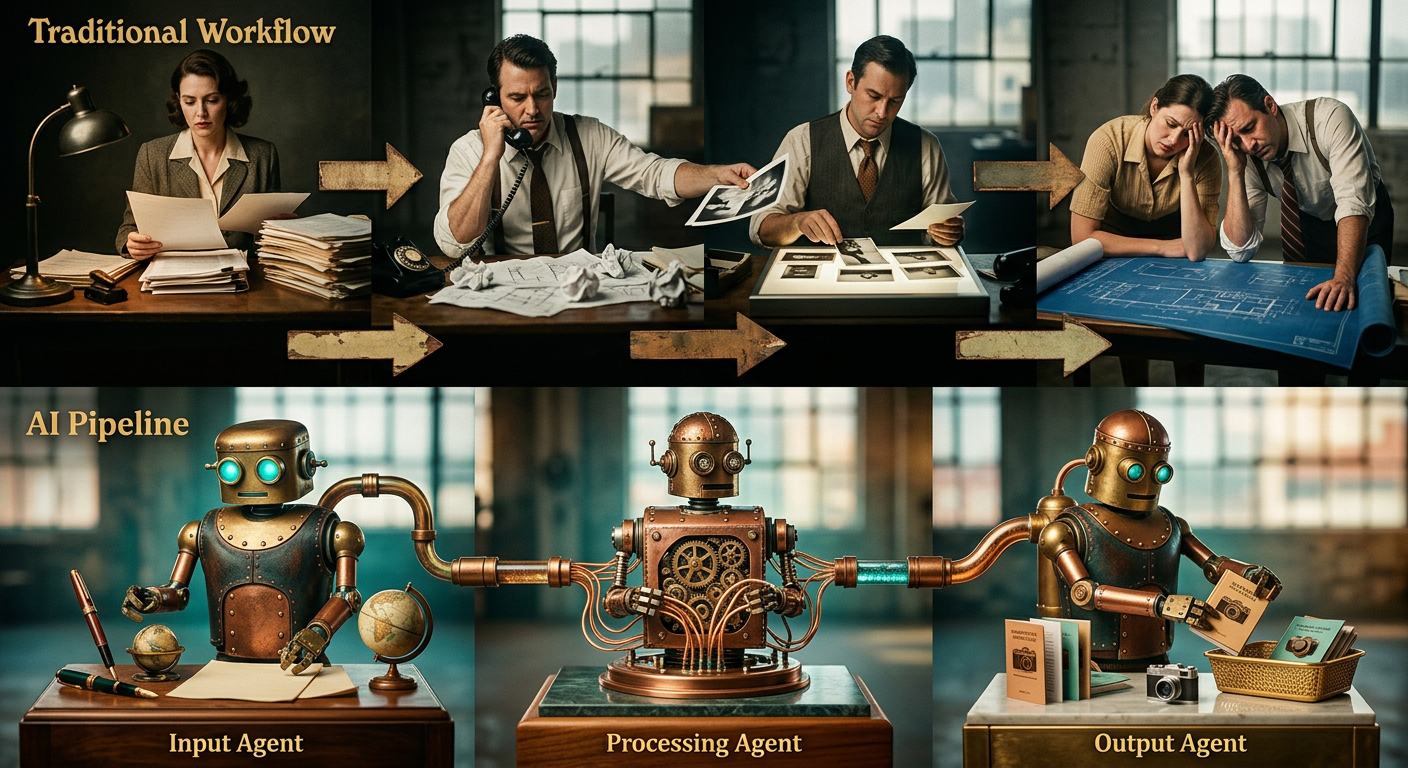
Let’s be honest about what most marketing agencies actually sell you: coordination. A strategist tells a copywriter what to write, who hands it to a designer, who sends it to an account manager, who emails it to you for approval — two weeks later. You’re not paying for results. You’re paying for the handoffs.


AI agents for marketing collapse that entire chain. One orchestrated system can research your audience, draft content, A/B test copy, publish across channels, and report results — without a single Slack message or status update call. That’s not hype. That’s what’s already happening at companies that have figured this out.
This post breaks down exactly what the new AI marketing stack looks like, which workflows it’s replacing, and how to build one that actually works for your business.
What “AI Agents for Marketing” Actually Means
An autonomous AI agent isn’t ChatGPT in a browser tab. It’s a model connected to tools — search, CRM, email platform, ad dashboard — that can take a goal and execute multi-step tasks autonomously. The difference between a chatbot and an agent is action. Agents don’t just answer questions. They do things.
A marketing agent might receive the instruction: “Generate 10 LinkedIn posts for next month based on our top-performing content, schedule them, and flag any that get below 2% engagement for revision.” It doesn’t need a human to pull the analytics, write the briefs, or manage the calendar. It handles the full loop.
This is why the conversation has shifted from “AI tools” to “AI agents.” Tools assist. Agents replace workflows entirely.
The Three Layers of an AI Marketing Stack
- Orchestration layer: The “brain” that coordinates tasks — typically built on frameworks like LangChain, AutoGen, or CrewAI
- Execution layer: Specialized agents that handle specific functions — one for content, one for ads, one for outreach
- Integration layer: Connections to your real tools — HubSpot, Google Ads, Notion, Slack, your CMS
Get these three working together and you have a marketing system that runs around the clock, without sick days or scope creep.
The 11 Marketing Workflows AI Agents Are Already Replacing
This isn’t speculative. According to recent B2B marketing analyses, AI agents are actively replacing 11 distinct marketing workflows in 2026 — from lead qualification AI to campaign reporting. Here’s where the displacement is most pronounced:
1. Content Production
The most obvious one. Agents like those built on GPT-4o or Claude can research a topic, pull competitor data, draft long-form content, and optimize for SEO — all in a single pipeline. Tools like Jasper, Writer, and custom agents built on n8n or Make are handling editorial calendars that used to require a full content team.
We’ve built content pipelines at GSI that take a keyword brief on Monday and have SEO-optimized drafts ready for human review by Tuesday morning. No writer assigned. No brief meeting. Just output. If you want to see what that looks like for your business, check out our content automation service.
2. Paid Ad Management
Uploading 50 ad variations manually, downloading CSVs, pausing losers, adjusting bids — this is exactly the kind of repetitive, rules-based work AI agents eat for breakfast. Platforms like Madgicx and Opteo already offer agent-like automation for Meta and Google Ads. Custom-built agents can go further: monitor performance hourly, rewrite underperforming copy, and reallocate budget without human input.
3. Social Media Management
Scheduling posts is table stakes. The real value is agents that monitor engagement, respond to comments, identify trending topics in your niche, and generate platform-native content formats — all without a social media automation logging in. Our social media automation workflows do exactly this for clients across multiple industries.

4. Outbound Sales and Lead Nurturing
This is where things get interesting. AI agents can pull prospect data from LinkedIn, enrich it via Clay or Apollo, write personalized outreach sequences, send emails, track opens and replies, and update your CRM — autonomously. The human only steps in when a prospect signals real intent.
One creator documented replacing a 5-person marketing team with 4-5 AI agents handling this exact workflow — research, outreach, follow-up, and reporting. The ROI wasn’t marginal. It was structural. Take a look at how we approach this in our outbound sales automation service.
5. SEO and Content Strategy
Keyword research, content gap analysis, internal linking audits, meta description generation — agents connected to tools like Ahrefs API, SEMrush, or Screaming Frog can run these workflows end-to-end. What used to be a monthly agency deliverable becomes a continuous background process.
6. Campaign Reporting
Nobody loves building dashboards. Agents can pull data from all your marketing platforms, summarize performance, flag anomalies, and write the narrative that goes in your weekly report. Supermetrics combined with an LLM layer is already doing this for sophisticated teams.
Why Traditional Agencies Can’t Compete With This
The structural problem for agencies is unit economics. An agency charges you for human hours. When a task takes an agent 4 minutes instead of 4 hours, the agency’s revenue model collapses — unless they’re the ones building and running the agents.
That’s the real disruption. Not that AI is smarter than marketers (it often isn’t). It’s that the cost per task drops 90%, and the speed per task increases by 10x. No agency built on billable hours can match that math.
As Tim Offutt noted on LinkedIn, what marketers spent years doing manually — uploading ads, analyzing performance, pausing losers — is now a 30-minute setup for a 24/7 growth engine. The people still doing it the old way aren’t just slower. They’re operating with a structural disadvantage.

Building Your Own AI Marketing Stack: Where to Start
You don’t need to replace everything at once. The smartest approach is to identify your highest-volume, most repetitive marketing task and automate that first. Build confidence in the system before expanding it.
Step 1: Pick One Workflow to Own
Start with the workflow that’s costing you the most time or money. For most businesses, that’s either content production, lead outreach, or ad management. Pick one. Build the agent for that. Measure results for 30 days before adding more.
Step 2: Choose Your Infrastructure
You have three real options:
- No-code/low-code: Make (formerly Integromat) or n8n for connecting tools with AI steps built in — best for teams without technical resources
- Agent frameworks: CrewAI or AutoGen for multi-agent orchestration — better for complex, multi-step workflows
- Custom builds: Fully bespoke agents built on your stack — highest performance, requires engineering support
If you’re a non-technical founder, start with Make or n8n. If you need something custom that integrates deeply with your existing systems, that’s where working with a specialist pays off. We cover both approaches through our custom AI development service.
Step 3: Keep Humans in the Right Places
The goal isn’t zero humans. It’s humans doing high-judgment work — brand voice decisions, creative strategy, relationship building — while agents handle everything that’s rules-based or repetitive. The best setups have a human reviewing agent output before it goes live, not managing every step that produces the output.
Step 4: Measure What Changes
Track output volume, error rate, cost per piece of content or per outreach sequence, and time-to-publish. These metrics will tell you whether your agents are actually replacing work or just adding complexity. Good agents show up clearly in the numbers within the first month.
Real Tools Powering Real AI Marketing Stacks in 2026
Here’s a practical snapshot of what a working AI marketing stack looks like today:
- Content: Claude or GPT-4o for writing, Surfer SEO for optimization, Notion AI for editorial management
- Social: Buffer or Publer for scheduling, custom agents for comment monitoring and engagement
- Outbound: Clay for enrichment, Instantly or Smartlead for email, AI personalization layer on top
- Ads: Madgicx for Meta, Opteo for Google, custom reporting agents via Supermetrics
- Orchestration: n8n or Make connecting all of the above
None of this requires a 6-figure tech budget. Most mid-size businesses can run a capable AI marketing stack for under $2,000/month in tool costs — a fraction of a single agency retainer.
 our tech stack diagram showing the tools listed above connected in a marketing automation flow, with arrows indicating data mov" title="">
The Honest Tradeoffs
AI agents for marketing aren’t perfect. There are real limitations worth knowing before you go all-in.
Brand voice drift is a genuine issue. Agents produce consistent volume but can lose the subtle personality cues that make your brand recognizable. You need clear prompting guidelines and human review for anything customer-facing.
Hallucination risk matters in regulated industries. If your agent is writing claims about your product, you need fact-checking steps in the workflow. Don’t skip them.
Setup takes real effort. The promise of “set it and forget it” is about 80% true. The first 20% — configuring tools, writing prompts, testing edge cases — requires genuine expertise. That’s the work you’re either doing yourself or hiring someone to do properly.
According to recent analysis of AI marketing agent use cases, the highest-performing implementations all share one characteristic: a human expert designed the workflow before the agent started running it. The agent executes. The human architect still matters.
What This Means for Your Business Right Now
If you’re paying a marketing agency $8,000–$15,000 a month and getting 10-day turnarounds on deliverables that an agent stack could produce in hours, that’s a gap worth closing. Not because agencies are bad — it’s because the economics have shifted fundamentally.
The companies moving fastest right now aren’t waiting for the technology to mature. They’re building agent-first marketing operations today, learning what works, and widening their lead over competitors still managing spreadsheets and briefing documents.
The question isn’t whether AI agents will replace traditional marketing workflows. That’s already happening. The question is whether you’re going to build the stack that works for your business, or keep outsourcing to teams that are figuring it out at your expense.
Ready to build an AI marketing stack that actually replaces the agency overhead? We’ve done this for businesses across e-commerce, SaaS automation, and professional services — and we know where the shortcuts are and where you can’t cut corners. Get in touch with our team at GSI and let’s map out what this looks like for your specific situation.