Best AI SDR Tools 2026: 9 Honest Reviews (Pricing, Weaknesses, What Actually Works)


Quick Summary
Your BDR team sends 500 emails a week. Maybe 15 people respond. Three of those turn into meetings. One becomes a customer. That’s not a criticism of your BDRs.
Your BDR team sends 500 emails a week. Maybe 15 people respond. Three of those turn into meetings. One becomes a customer. That’s the math most sales teams are living with in 2026 — and it’s exactly why every founder I talk to is looking at AI SDR tools like they’re the answer. Some of them are. Most of them aren’t. Here’s the honest comparison.


 Claude API.svg" alt="claude logo" style="height:32px;width:auto;display:inline-block;margin:0 8px;filter:grayscale(50%) brightness(1.5);opacity:0.7;" title="">


What AI SDR Tools Actually Do
So an AI SDR tool. It’s short for AI Sales Development Representative. It’s somebody, well, software, that finds prospects. Writes the first email. Sends LinkedIn messages. Runs the followup sequences. And sometimes they even book it on the calendar. Pretty much your whole top of the funnel motion automated.
The category first like blew up on the scene back in 2024. That’s where we first started using it. We were using it during a lot of cold email outreach. We have a good familiarity with about more than half the software on this list firsthand. I mean, intensively. We’ve tried these. But a good, a good many hours have been spent with about half the software that’s gonna be listed below. And to be honest with you, back in the day, they were all garbage. A lot of times we were using Smartlead or maybe even a third party emailing software. We’re having like 10 to 15 email boxes going out, sending you know, 50 plus emails a day, usually not more than that. And we were using it with Zapier mixed in.
Now at the time, they were all just like GPT-3.5 wrapped sort of like around a Mailchimp sequencer. And they were calling it AI. But anybody who used them back then was getting like a 1% reply rate. And the deliverability, how you’re dealing with it was just a mess.
Fast forward to 2026 and it’s a lot different because these tools have really taken the power and things they were using back then and they’re what we call now quote unquote agentic. Right? So agentic AI SDR, similar to how the person in SDR would be. It doesn’t just fire off emails. It also takes actions, watches the responses. And the thing is it decides the next move. And sometimes it loops if it needs to. It’s multiple steps. It’s a flow. It changes. It varies. The decision that needs to be made based on the action that’s taken by the other person. Whether it’s opening the email or replying or not replying, or you know, setting at a time or whatever. It’s very, very smart.
This is not just a feature. It’s basically different in the fundamental architecture of the whole software.
So there are three jobs an AI SDR can do, and they can do them well. It can prospect — which basically means it’ll find the right humans for the right companies that you’re looking for. It can personalize outreach, you know, basically writing a message to that person, something that won’t trigger their “this is an AI response” radar. Hopefully. It can sequence and followup basically six to eight times without annoying. Right? Like, I mean, what’s the right number to followup with somebody?
Now most of these tools that were claiming the AI SDR label only nail one or two of these things. So maybe four tools in the market actually do all three at a level you’re putting in front of a buyer. We’re going to tell you which ones of these are worth mentioning.
One more thing before we go through the list. The cost shift here is pretty real. Okay, so human SDR loaded. You got about salary, benefits, management overhead. You’re talking about $80,000–$120,000 a year. A good AI SDR stack is not cheap, okay? And obviously you got your lead costs or whatever else, but it’s still gonna run you $500 to $3,000 a month. Same volume of meetings booked, maybe — depending, you know, the quality varies depending how you tweak your stack. We’ll show you the math later.
But to be upfront, we don’t sell any of these. GSI doesn’t sell any tools. We just build the integration layer that makes the ones you already bought actually talk to other ones. So the comparison is honest. We don’t get a kickback from any of these.
The Best AI SDR Tools in 2026 (Honest Comparison)
1. Artisan AI (Ava)
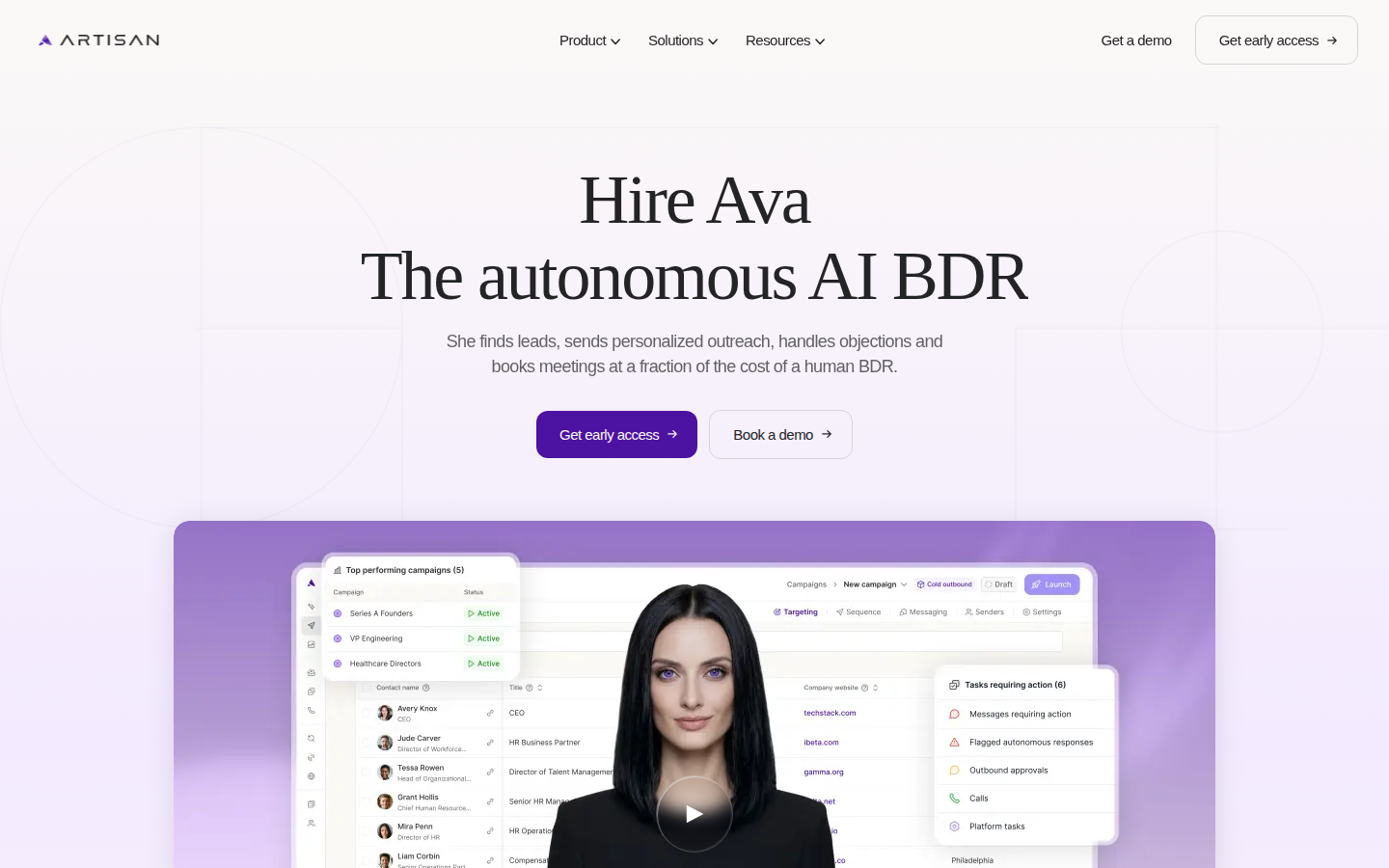
Artisan AI or Ava. Artisan pretty much made a big splash with billboards, if you were in San Francisco that were saying, advertising they stopped hiring humans. Great marketing campaign. You know that wins. But behind the marketing of Ava, Ava is an AI SDR that runs the whole outbound motion with a 300 million contact database. So that’s, if you think about it, that’s like almost all of America. You’re just gonna say every person is in there. But obviously this is international.
You don’t need to bolt on Apollo or ZoomInfo for data, which is kind of one of the benefits.
Pricing — it’s not publicly listed, so it’s kind of, you know, but the real world reports we’ve had, this is one of the ones we’ve not tried, but we’ve had good research on. It’s about $200 to $500 per month per user. You do have to book a demo to get the full quote, which is annoying.
What’s different about it? It’s one platform. It’s one bill. Most AI SDR setups require like four to five different tools stitched together. This one’s one that does kind of the whole thing. It ate the whole stack together.
It’s best for, really, probably outbound heavy B2B people or companies that want one vendor to deal with instead of like five contracts to manage.
Now the downside though, honestly, and this is the honest weakness, is the UI feels a little heavy, I mean from what we’ve seen. And experience feels a little heavy especially to new people just first trying. The onboarding is like a 2-3 week process from what we understand. And at high volume, the personalization can drift towards like a little bit of generic. Some Reddit threads call it out — there’s a gap between marketing and the actual deliverability. So you know, take that for what it is.
2. Jason AI (by Reply.io)
 autonomous AI agent product page" title="">
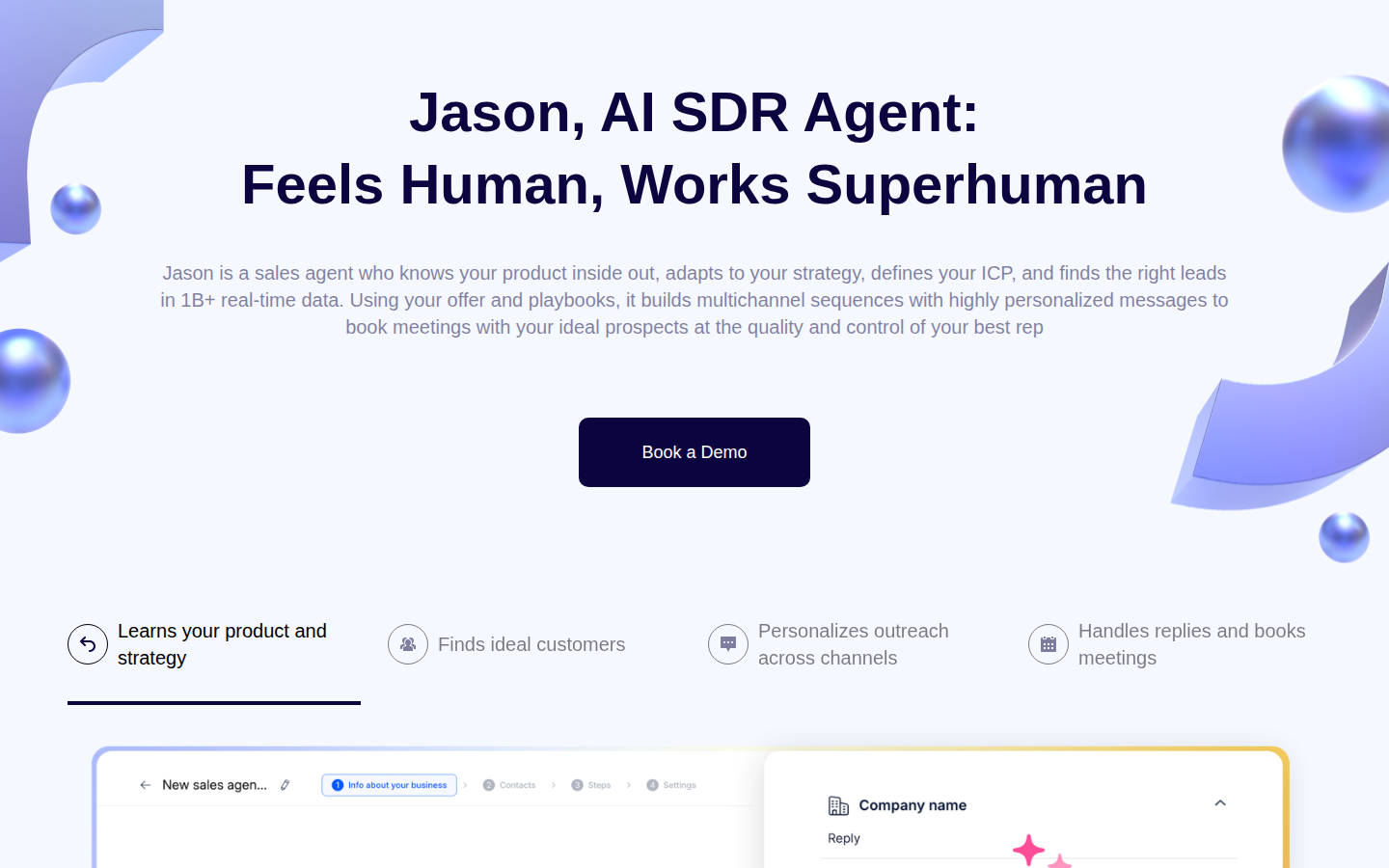
Next we have Jason AI, which is by Reply.io. It’s their AI agent, and it sits on top of their existing multichannel sequencer. The thing is, with this one, if you’re already a Reply customer, it works great. Jason just adds an AI brain to what you’re already doing. In fact, their motto is “Jason, AI SDR agent — feels human, works superhuman.”
Some of the things they advertise: it finds your ideal customer, puts you in touch across multiple channels, handles replies, and books meetings. This is all great, and it looks like it has a really good interface. Lets you create playbooks and offers. There’s tone and language settings. Plus you can pick your preferred AI model — Claude, Gemini, Mistral, OpenAI. Different ones do different things. Personally, I’d be using Claude if I had a choice for these. And then you can also target the account level — the companies you want to do — not much different than going through Apollo and picking different customers.
Pricing — Reply starts at $59 a month, which is a lot cheaper than a lot of the other ones. But sorry, I should take that back. Reply starts at $59 a month, but the Jason AI feature really starts at the $139 tier.
Big thing about this one — what’s different is that there’s zero migration cost if you’re already on Reply. Every other tool requires some kind of platform switch. This is best for, honestly, existing Reply users, especially ones who want to add AI personalization without changing tools. If you’re starting out of the blue, I probably wouldn’t suggest this one off the bat.
The replies lean templated — that’s kind of one of the weaknesses. You’ll catch the “AI wrote this” feel from a lot of these, especially more often than Artisan or AiSDR. The best AI features are probably gated behind a higher plan.
3. AiSDR
Number three on the list is AiSDR. It’s a multi-channel done right system. You can connect email, LinkedIn, SMS, and it has dynamic scripts that pull live LinkedIn data into the message. Which is convenient — something we were using Zapier and multiple tools at once to do back in the day. As in, like, a year or two ago. Not too far back in the day.
So instead of “Hi {first name}, I noticed you’re in {industry},” you get “Hey Sarah, congrats on your promotion to VP last week, saw the post.” Sounds a lot more natural.
Pricing on this one — it’s a lot more expensive, but it’s a lot better quality. You’re looking at around $750 a month just for 1,000 prospects to start. Custom plans are available if you do more than that.
What’s different about this one is that most tools fake the LinkedIn integration. This one actually pulls recent posts, job changes, and mutual connections into the personalization layer — something you might have to automate some other way otherwise.
It’s best for mid-to-large teams running high volume across email and LinkedIn together. It’s great if you want to keep those two connected and you’re targeting prospects on multiple platforms. In my opinion, setup takes one to two weeks and requires real training data — examples of your best emails, your ICP definition, your tone guide. If you only need email outreach, it’s probably overkill. This one is great if you can stomach the price point.
4. Coldreach
Number four on the list, Coldreach. Coldreach is a research-first play. Instead of spamming your ICP, it watches for buying intent signals — anything from funding rounds to exec hires, technology stack changes, leadership departures. Things that are happening at the company. And then on top of that, it’ll trigger an outreach the moment your message is most relevant. Whether it’s the VP getting fired or whatever it is.
Pricing on this one is custom. Real-world entry is around $500 to $1,000 a month.
What’s different about this software is the signal-to-noise ratio is dramatically higher. Reply rates from teams using Coldreach are sometimes two to three times higher than the industry average. And it’s not just because the AI is better, but because the timing is right. That’s the key.
It’s best for teams who love to work on trigger-driven moments — like I said, Series B AI for SaaS post-funding, or a company that just hired a new VP, or whatever you sell to. Post-IPO budget cycles. This is kind of the best way to trigger them.
There are some weaknesses though. It’s got a smaller signal library compared to enterprise intent vendors like 6sense or Bombora. Volume is lower by design — you’re trading reach for relevance on this one.
5. Salesforce Einstein
Salesforce Einstein. Einstein is Salesforce’s CRM-native AI layer. It’s predictive lead scoring, conversation intelligence, AI-generated email drafts. All of it happens within Salesforce, not in a third-party tool. So obviously you’ve got to be on the Salesforce platform to begin with, which is already pricey.
Pricing: You’re looking at $25 a user per month as an add-on. But you need Sales Cloud underneath, which is already $150 to $300 per user. So in the end, you’re looking at an additional $175 to $325 a month per user, depending.
It lives where your data is already at. What’s different: it’s great if you’re on Salesforce — though Salesforce itself can be a PITA, pain in the ass. There’s no CRM sync issues, no third-party data leaks, no “which system is the source of truth” arguments you’re having with the software. It’s all in there.
It’s best for enterprise teams already on Salesforce. Pointless if you’re not.
The honest weakness — garbage data in, garbage AI out. Einstein amplifies that quickly. Total cost of ownership balloons because of the required base licenses and add-ons. This is something we’ve never really used ourselves — we’re not on Salesforce — but we’ve heard good reviews on it.
6. Apollo.io
Apollo.io. Now Apollo, we’ve used in bunches. To be honest with you, it can get pricey. But then we’ve also scraped Apollo, so I can’t complain. Apollo is basically a Swiss Army knife. We’ve actually emailed customers from Apollo directly, and we’ve also scraped Apollo’s data — so it works both ways.
It’s got 210 million contacts in there. There’s a sequencer, there’s AI-enhanced filters. It’s an all-in-one tool. You can email Apollo contacts directly.
Pricing: It gets expensive fast though. It’s $49 a user per month. They do cap the number of emails you can send out with it. Generally there’s a Professional tier that starts at $79. If I recall, you’re paying for Apollo based on the number of emails you want to send out — and you’ve got to pay more for more emails.
What’s different: It’s a database and outreach in one software, which is great. There’s no separate enrichment vendor. It’s the cheapest serious option in this category. However, it’s not meant for mass cold emailing, at least not without some tweaking. You need to have some cold email experience to do that.
It’s best for solo founders, startups — usually 1 to 10 reps — or anybody testing the outbound market. I don’t recommend it for a bigger stack though.
The honest weakness is the lower-tier sequencer limits feel restrictive once you scale past 50 sends a day. I really wouldn’t recommend it for more than maybe 50–100 total emails a day. The AI personalization is also shallower than some of the other dedicated tools. Apollo is a generalist in a sense — it’s not a specialist.
7. Outreach.io
Outreach is basically a sales engagement platform. I mean, it’s definitely a sales tool — you can automate outreach. It’s the original sales engagement platform, as far as the big guys know. It’s been around for a few years now. A lot of the big sales organizations run on it. It’s their big sales system.
Pricing — the thing with this one is it’s custom. There are real-world contracts reported anywhere from $130 to $180 per user per month. But most times they’ve got like a $25,000 annual minimum — at least that’s reported.
What’s different though, is that the depth of workflow and customization is unmatched. Unlike the other ones, the branching sequences adapt to every little behavior — whether that person opened or didn’t open an email, replied, ghosted, clicked, didn’t click, etc. It’s really very intuitive.
Best for 25+ rep enterprise teams — sales teams with a dedicated RevOps function to maintain it.
Honest weakness though — it’s very unclear on pricing. Opaque pricing, if that’s what you want to call it. It’s locked in with annual contracts most times, from what we’ve seen. And integration headaches, especially with HubSpot — that should be something that’s not as prevalent as it is with today’s technology, but here we are in 2026 and it can still be a pain. Honestly though, it’s pretty much total overkill for anybody with under 25 reps.
8. Reply.io
Reply.io is a good one. It’s standalone — it’s very comparable to the Jason add-on from earlier. It’s also a sales engagement platform, kind of like Outreach, but it’s more for cold email. It’ll also handle LinkedIn outreach.
It’s probably one of the more affordable tools on this list that does multi-channel. Like I said, it does email, LinkedIn, calls, SMS — all from one platform, which is convenient. Most of the other multi-channel tools are email-only with LinkedIn like duct-taped on. Reply isn’t.
Pricing though, like I said, it’s pretty affordable. $59 a month for starting price. AI features like Jason unlock at around $139.
What’s different is that real multi-channel at SMB price. Closest competitor, I’d say, is Outreach — costs two to three times more.
It’s best for mid-sized teams or smaller teams. Five to 20 reps is a good deal. They need email, they want LinkedIn, SMS, all in one. Although, you know, a solopreneur could definitely get away with it.
Honest weakness though — it’s kind of got a steep learning curve. The UI is definitely dated. And the best AI features are behind the top tier.
This is basically just Reply without Jason. Tool 2 covered Reply with Jason — made the distinction there.
9. 11x.ai (Alice and Mike)
Number nine — 11x.ai, aka Alice and Mike. This is definitely your quintessential AI sales agent, or AI agent you can automate.
11x — or llx, whatever — sells AI SDRs as digital workers, not software. Alice handles outbound. Mike handles inbound. Case you want to have a guy-and-girl agent team, well, there they go. They have names, profile photos, Slack handles, etc. The marketing is genius behind it, because buyers really feel like they’re hiring an employee, not a tool. Which obviously, this is completely an AI.
Pricing — so far, it’s enterprise only. Reports of it go between $50,000 and $120,000 for Alice alone.
What’s different is the framing. Buying Alice feels like adding headcount, which makes the budget conversation different. Underneath, it’s similar to just an Artisan or AiSDR. Honestly, you give me $120,000, I’ll give you three Alices for that price.
It’s best for funded startups, Series B, and enterprises that want to outright replace one to three SDR seats.
The big weakness — it’s expensive. Requires clean data input. Garbage in becomes garbage outreach faster. Reddit has buyer remorse threads about the delivery falling short of the marketing pitch on this one. I mean, you just search even deep and hard — you’ll find them.
How to Choose the Right AI SDR Tool for Your Team
Okay so you’ve got nine tools above. Now what. How do you actually pick one, right? The thing is, most people — honestly, they do this wrong. They look at pricing first. Then features. Then they pick based on, you know, whichever demo rep was most charming that week. I mean, don’t do that. It’s how you end up with a $2,000 a month tool sitting unused after six months.
The real question — and this is kind of the thing nobody asks — is: what’s your sales process already look like, and where’s it broken? Because here’s the reality. An AI SDR tool doesn’t fix a bad sales process. It just runs a bad sales process faster. Which, if you think about it, is worse. If your message isn’t resonating when a human sends it, it’s not magically gonna resonate because a bot sent it. That’s not how it works. Ever.
So step one, honestly — audit what your SDR team or sales rep is actually doing all day. Breaking it down. How much time is prospecting. How much is writing the first message. How much is followup. How much is qualifying leads. How much is meeting booking. Usually — and we’ve seen this a hundred times — what you find is like 60 to 70% of a sales rep’s day is just followup and lead qualification. Which, by the way, is exactly what AI SDRs are actually good at.
If your answer to “what’s your sales process” is like “we don’t have one, we just wing it” — okay, don’t buy an AI SDR tool yet. Build the process first. Pick three ICPs. Write three messages per ICP. Define what a qualified lead looks like. Pick a cadence — 7-day followup, 3-touch, whatever feels right. And do it manually for 30 days. I know it sucks. But then you layer in the AI. Not before.
Second thing — figure out your channel. Where does your buyer actually live? If they’re on LinkedIn, Apollo or a pure email tool isn’t gonna do you much good. You want linkedin outreach plus email, you go AiSDR or Reply. If your buyer is reachable at scale with just email, honestly, Instantly or Smartlead is probably cheaper and fine. And if you’re selling to enterprise and they’re already using HubSpot or Salesforce, you probably want Einstein or something that plays nice with those CRMs. Not a third-party tool that’s gonna create sync issues. Trust me on that one.
Third — match the tool to your team size. And I mean actually match it, not aspirationally match it. For solo founders or a 2 to 5 person sales team, Apollo plus a lightweight sequencer does the job. For 5 to 20 reps, Reply or AiSDR. For 25 plus reps with a full sdr team and a RevOps person, Outreach or Einstein. For a company that literally — like, literally — wants to not hire more sales reps, 11x or Artisan.
Last thing. Don’t just pick based on features. Features are features. Pick based on what you’ll actually use. I mean, I’ve seen companies — real companies, our clients — buy a $2,000/month AI SDR tool and use like 15% of its features. Meanwhile a $300/month tool with the right followup sequences would’ve outperformed them by 2x. The best ai sdr for you is the one you’ll actually operate. That’s it.
AI SDR vs Human SDR — What Each Still Does Better in 2026
I’m gonna be pretty honest about this because there’s a lot of marketing BS in the AI SDR space right now. Like a lot. The pitch you see from 11x and Artisan and basically everyone — it’s “replace your SDRs.” That’s the dream, right? That’s the pitch. It’s not quite the reality. At least not yet. Maybe someday. But not today.
Okay so here’s where AI SDRs win, and they win clearly. Volume. A human SDR can do maybe 100 personalized emails a day if they’re cranking, I mean really cranking. An AI SDR can do 1,000. And each one actually references the prospect’s recent post, their company’s recent funding, whatever. Followup discipline — this is a big one — humans give up on followup after touch 3. Like, always. The AI doesn’t. It just keeps going. Message consistency across a whole sales development team, that’s another one. And cost — I mean a human SDR costs you $80 to 120K loaded, a decent AI SDR stack is $1 to 3K a month. On pure math, AI wins automated outbound sales at scale. Full stop.
Now here’s where humans still win. And this is the part the 11x marketing doesn’t wanna talk about. Reply rates at low volume. If you’re doing 10 hyper-targeted accounts with a real personalized message from a real person, a human will beat any AI, hands down. It’s not close. The AI is optimized for “good enough at scale” — the human is optimized for “great, one at a time.” Response rate on those high-value accounts is maybe 3 to 5x better with a real sales development representative on the job.
Qualifying leads. This one’s actually interesting to me. AI can qualify leads on the surface — firmographic stuff, intent signals, response tone. That’s fine. But for complex sales, where the question is “is this really a fit given their internal politics and buying committee structure” — humans still win. Lead qualification on a $500K ACV deal is not something you hand to an AI agent. I mean, would you? Probably not. I wouldn’t.
Meeting booking follow-through — this one gets overlooked. An AI can book a meeting. Cool. But if the prospect cancels, reschedules, goes dark for 2 weeks, then pops back up with a vague “let’s revisit” — a human sales rep navigates that way better. Good AI SDRs handle the first 70% of the sales cycle. Humans close the last 30%. That’s kind of the split right now.
And complex sales in general. Multi-stakeholder, long-cycle, non-linear deals. AI SDRs are designed for linear top-of-funnel. The moment a deal gets messy — champion leaves, procurement intervenes, legal redlines — you need a human. I mean obviously.
Reply rate reality check real quick. Every AI SDR vendor claims 5 to 10% reply rates. You know what real-world data from teams using these tools, talking to us, looks like? 1.5 to 3% average. Still fine. You’re doing 10x the volume of a human, so 2% of 10,000 beats 8% of 500. Just — don’t let the marketing fool you into thinking it’s magic. It’s not magic. It’s math.
So my honest take: full sdr replacement is still like 18 to 24 months away for most B2B teams. Right now? Best play is AI for volume top-of-funnel, humans for high-value accounts, and humans closing the deals. Hybrid stack. That’s where we are. That’s what actually works.
The Real Cost Math: AI SDR Tools vs a Human SDR Team
Let’s actually run the numbers because, I mean, everyone throws around “10x cheaper” and it’s rarely that clean. Let me show you.
Human SDR team, 3 reps. $85K base each, plus benefits and overhead, plus you know $2K a month in tools — LinkedIn Sales Nav, Apollo, Outreach. You’re looking at roughly $330K a year all in. For that, you get maybe — maybe — 150 to 180 meetings booked per month across the three reps. Cost per meeting booking? Roughly $180 to $220. Not terrible but not great either.
Same volume with an AI SDR stack. Artisan or AiSDR at $2K a month, plus $800 a month in data and tool integrations, plus a part-time human RevOps person to maintain it — call it $3K a month fractional. You’re at around $70K a year. For the same 150 to 180 meetings? Only if your message and ICP are really tight. More realistically, you’re getting 120 to 140 meetings because the reply rate is just lower. Cost per meeting though — $40 to $50. That’s a big gap.
Big caveat though, and this matters. Meeting quality. Human SDRs qualify leads on a real 5-minute call before booking. AI SDRs book on calendar links, which means — yeah — more no-shows, more “wait, why am I on this call,” more unqualified pipeline. Net show rate on AI-booked meetings is maybe 55 to 65%. On human-booked, it’s 75 to 85%. So adjust accordingly.
Where the AI stack wins outright: small sdr team replacement. If you’re a 10-person company considering hiring your first two SDRs at $180K combined — honestly, buying an AI SDR tool instead and running it with one of your existing founders or ops people makes a lot more sense. Way more sense. The full SDR hire doesn’t really pencil out under $3M ARR in most cases we’ve seen. Maybe $2M if you’re lucky and your ACV is high enough.
Where human SDRs still win the math: you’re at $10M plus ARR, selling complex sales into enterprise, six-figure ACVs. A good human sales rep on your top 50 target accounts generates way more pipeline than any AI tool. Don’t cheap out on that. Seriously.
Hybrid stack — which is what most of our clients end up running anyway — is typically like: 1 human sales rep on top 100 accounts, AI SDR tool running the other 900 to 5,000 accounts on volume. That’s where the cost-to-pipeline math really sings. You use AI to do what AI is good at — volume, followup, personalization at scale — and humans to do what humans are good at. Relationship. Complex sales. Closing. That’s it. That’s the playbook.
Why Most AI SDR Tools Fail (The Integration Problem)
Okay so here’s the thing nobody tells you when they’re selling you an AI SDR tool. The tool isn’t the problem. Really. The integration is. I’ll say it again because people don’t get this. The integration. That’s the problem.
Every AI SDR I listed above works great in a demo. Clean data, ideal ICP, perfect followup cadence, beautiful message templates. Looks amazing. Then you actually connect it to your CRM and everything breaks. Like everything. HubSpot contacts get duplicated. Salesforce custom fields don’t map. Your Apollo list goes stale 30 days in because nobody’s syncing it back. The AI starts following up with prospects who already closed six months ago. It’s just a mess.
We see this constantly. Like every week. A client buys tools like Artisan or 11x expecting it to just work out of the box. Three months in, they’re paying $2 to $5K a month, their sales team hates the platform because it’s giving them noise — noise, not signal — and their AI tool is basically sending auto-generated email outreach to the same 50 people who’ve already said no three times. And then those people are angry. Because of course they are.
Root cause: these sales tools are built to win demos, not to integrate with your existing stack. They want you using their CRM, their sequencer, their analytics. Their everything. But you already have a CRM. You already have a sequencer. You don’t want a fifth ai tool in your stack — you want the four you already have to actually work together. That’s the ask.
This is literally — and I mean literally — what GSI does. We don’t sell AI SDR tools. We don’t get a kickback. We build the integration layer between your AI tool and your HubSpot or Salesforce or whatever CRM you’re running. Make sure contact data syncs both ways. Make sure the AI doesn’t re-outreach closed-won accounts. Make sure meeting bookings land on the right rep’s calendar with full context attached. Basic stuff. But nobody does it.
Honest rule here: your AI SDR tool is only as good as the integration underneath it. If you buy top AI SDR software but don’t wire it up right — you’ll get worse results than a $200/month email tool that’s properly connected to your pipeline. Every time. Every. Single. Time.
So when you’re picking a tool, ask the vendor — straight up — what’s your integration story with HubSpot? With Salesforce? With my existing sales engagement platform? If the answer is “we have a Zapier integration,” honestly, just run. Zapier is duct tape. I love Zapier. We use it. But it’s duct tape. It works for simple stuff. For a real AI SDR workflow? You want native integrations or a proper middleware layer. We’ve built that layer for dozens of teams now — if you’re evaluating, we can help you figure out what actually plugs in cleanly. That’s kind of our thing.
AI SDR Tools and the Bigger Picture for 2026 B2B Outbound
Stepping back for a second. Where is all this actually going? Because the AI SDR category is moving fast and 2026 is not gonna look like 2025. It’s just not.
Big shift number one — AI sales agents going multi-modal. Right now most ai sdrs do email and LinkedIn. That’s it. By end of 2026? The serious ones will be doing cold outreach via SMS, voicemail drops — yeah, voicemails are back, AI-generated ones — and even AI-initiated phone calls. Alice from 11x is already piloting voice. This is gonna change what top-of-funnel looks like. Not necessarily for the better, honestly. If you’re getting AI calls, AI texts, AI emails, AI LinkedIn messages all in one week? The fatigue is gonna be real. We’re already seeing early signs of it.
Second shift — personalization depth. Current AI sales agents are doing a good job at surface-level personalization. They mention your last post, your recent funding, whatever. It’s fine. The next generation is doing deep contextual personalization — analyzing your podcast appearances, your GitHub activity, your company’s recent product launches, even internal reorgs reported on Glassdoor. I mean it’s getting kind of intense. The first message you get from an AI agent in late 2026 is going to feel genuinely like a human wrote it after researching you for an hour. That’s both cool and, honestly, deeply unsettling. I don’t know how I feel about it yet.
Third shift — and this is where B2B gets interesting — agentic workflows. Right now AI SDRs send messages. Soon? They’ll be running whole multi-step sales tasks. Booking the meeting. Prepping the sales rep’s call notes. Sending the follow-up recap. Updating the CRM. Scheduling the next touchpoint. Each of those is a sales task that today takes 5 to 15 minutes of a human’s day. When AI does all of it reliably — which isn’t quite here yet but it’s close, like really close — the whole role of a sales development representative changes.
What does a sales rep do in 2027 when AI handles prospecting, messaging, qualifying leads, and meeting booking? Two things. They handle complex sales conversations that AI can’t. And they manage the AI sales team — tuning prompts, reviewing outputs, catching hallucinations, making sure the AI isn’t burning bridges with good accounts. It’s less a sales role and more a sales ops plus player/coach hybrid. Which, honestly, is maybe a better job. Maybe.
For outbound sales specifically, the B2B playbook for 2026 is: AI does the volume. Humans do the relationship. The integration layer between them is the real moat. The companies that win in 2026 are not the ones with the fanciest AI tool. They’re the ones whose AI tool actually plugs into their sales cycle without breaking it. Full stop.
How to Build Your 90-Day AI SDR Roadmap
Alright so you’ve decided to actually do this. Good. Here’s how I’d roll it out. Don’t try to do everything in week one. Don’t. Most teams that fail at AI SDR adoption fail because they tried to fully automate on day one and had no baseline to compare it to. They don’t know if it’s working or not. That’s the whole problem.
Month 1 — manual baseline. Before you buy any ai tool, run your outbound manually for 30 days. Same ICP. Same message templates. Same followup cadence you plan to use with the AI. Track reply rates, meetings booked, meetings actually held, pipeline generated. All of it. This is your baseline. You’ll come back to these numbers when the AI vendor claims they 10x’d your pipeline — and you’ll actually know whether they did or not. Trust me, this step saves you money later.
Month 2 — pick one channel, one tool, one ICP. Don’t try to run AI across email plus LinkedIn plus SMS on day one. I mean, don’t. Pick the channel where you have the most volume and the most baseline data. If you’re email-heavy, start with Reply or Smartlead. If LinkedIn-heavy, AiSDR. Connect it to one ICP, not all three. Run it for two weeks. Just two weeks.
Month 2, weeks 3 and 4 — compare against baseline. Did reply rates go up or down? Meetings booked — up or down? Meeting show rate — up or down? Sales cycle length — shorter or longer? If the numbers are worse — and this is important — don’t add more AI. Fix the message. Fix the followup. Fix the targeting. Then try again. Don’t just throw more tools at it. That’s how you end up with a $5K/month AI stack that does nothing.
Month 3 — layer in the second channel. Now that you’ve got the first channel dialed, add the second. If email is working with AI, layer in linkedin outreach. Same ICP. Same core message, adapted for channel. Track whether adding the second channel actually lifts reply rates or just adds noise. Sometimes it’s noise. Be okay with admitting that.
Month 3, end — decide on the integration layer. By now you’ve felt the pain of data syncing. The AI tool not talking to your CRM. Duplicate contacts. The whole mess. This is when you either build the integration layer yourself — painful, not recommended for most teams — or hire someone to build it, or find a partner. Hi, that’s us. The integration decision is actually more important than the tool decision. Spend more time on it.
After 90 days you’ll know three things. Which tool fits your motion. How much real lift the AI gives you over your baseline. And what the true cost of operation is — not just license cost, but RevOps time, integration cost, monitoring, all of it. Then you either double down and roll out to the full sdr team, or you cut bait and try a different tool. Either way, you actually know something. That’s the point.
Tools 10-13: Instantly, Clay, Smartlead, and More (Coming Soon)
Quick heads up — we’re currently recording the reviews for the next four. Instantly.ai — pure email volume, super affordable, popular with solopreneurs. Clay.com — data enrichment plus workflows, not exactly an AI SDR but it’s kind of becoming one. Smartlead — multi-inbox cold email infrastructure, we’ve used it in bunches, honestly. And a bonus review of Lavender.ai — automated email handling coaching, sits on top of whatever tool you use. Check back. We’ll update this post with the full reviews and real-world pricing in the next week or so. Pinky promise.
FAQ: AI SDR Tools
What’s the top AI SDR tool for a small team in 2026?
Honest answer? For a small team — let’s say 2 to 5 reps — the top ai pick is probably Reply.io with Jason AI turned on. $139 a month. Real multi-channel. And you can actually use ai without hiring a RevOps person to maintain it. Apollo’s a close second if you want a database too. If you’re a solopreneur, Instantly is fine. Don’t overthink it.
Can AI SDRs fully replace my SDR team?
Short answer — no, not in 2026. Long answer — AI SDRs can replace maybe 60 to 70% of the work a junior SDR does. Prospecting, personalize outreach, followup, basic lead qualification. The other 30 to 40% — complex sales conversations, multi-stakeholder stuff, closing the meeting when it goes sideways — still needs a human. Think hybrid, not replacement. For now anyway.
What’s the real difference between AI SDR tools and traditional sales engagement platforms?
Traditional sales engagement platforms — Outreach, old Salesloft, whatever — are basically sequence runners. You feed them a list, you feed them messages, they send. That’s it. AI SDRs add the agent layer on top. They find the prospects. They write custom messages per prospect. They decide when to followup. They adapt the cadence based on response. The sales engagement tool executes. The AI SDR decides. Big difference.
How do I know if my company’s ready to use AI in outbound?
Three things. First — you have a defined ICP. Not “SaaS companies” but “Series B SaaS companies with 50 to 200 employees selling to mid-market finance teams.” Specific. Second — you have a sales process that works manually. You know what works because you’ve done it the hard way. Third — you have someone who can maintain the ai tool, even part-time. If any of those three are missing, fix them before you buy any AI SDR software. Otherwise you’re just automating a broken process. And that’s worse than not automating it.
What are the hidden costs of AI SDR tools?
Okay, the hidden costs. Data costs — Apollo, ZoomInfo, whatever enrichment source feeds the tool. Integration costs — connecting to your CRM, especially if you’re on HubSpot with custom fields. Maintenance time — a fractional RevOps person, call it $2 to 3K a month. Deliverability costs — warmup services, inbox rotations, domain management. All of it. Budget 30 to 50% on top of the license cost for the real monthly spend. That’s the real number.
Which AI SDR tool has the best LinkedIn outreach?
AiSDR does the deepest LinkedIn integration. Pulls live posts, job changes, activity data, all that. Jason AI from Reply is a close second. Most of the pure email tools have bolted-on LinkedIn that feels like an afterthought — because it is. If LinkedIn is a core channel for you, don’t compromise on this one. Just don’t.
Want help building an AI SDR stack that actually works? Get in touch. We’ll audit your current sales process and show you exactly where AI can multiply your output without multiplying your costs — and more importantly, where the integration gaps are that’ll break it if you don’t plan for them. That’s the part everyone skips.